How to Read Mark
Mark moves quickly, but it is not shallow. The Gospel is carefully arranged. The opening line announces Jesus as the Messiah and Son of God, but from there Mark mostly lets the story reveal that claim through Jesus' actions, words, conflicts, suffering, death, and resurrection. The reader is meant to watch how everyone around Jesus responds and then decide how they will respond too.
Mark presents Jesus as the suffering Messiah who becomes king through service, rejection, death, and resurrection.
Again and again, people ask or imply the question: Who is this? The crowds marvel, the demons know, the disciples misunderstand, the leaders oppose, and finally a Roman centurion confesses at the cross, "Truly this man was the Son of God."
- How often Mark uses urgency and movement.
- The tension between Jesus' power and his hidden identity.
- The repeated failure of the disciples to understand him.
- The shift from Galilee → the road to Jerusalem → the city itself.
- How Jesus redefines messiahship around suffering and service.
- How the ending leaves the reader with a decision to make.
"The beginning of the good news of Jesus the Messiah, the Son of God."
The Reader Knows. The Characters Don't.
This is the engine of Mark's dramatic tension. The narrator tells you the answer in line one — Jesus is the Messiah, the Son of God. But from that point forward, Mark gives that information to almost no one inside the story. Demons recognize Jesus and are silenced. Crowds are amazed but confused. The disciples confess and then immediately misunderstand. Religious leaders never get it at all. The only person who openly confesses Jesus as the Son of God is a Roman soldier standing at the foot of a cross — the very last place anyone expected.
This gap between what the reader knows and what the characters know is called dramatic irony — and Mark sustains it for fifteen chapters. It is not a narrative flaw. It is Mark's way of pressing the reader to keep asking: who is Jesus to you?
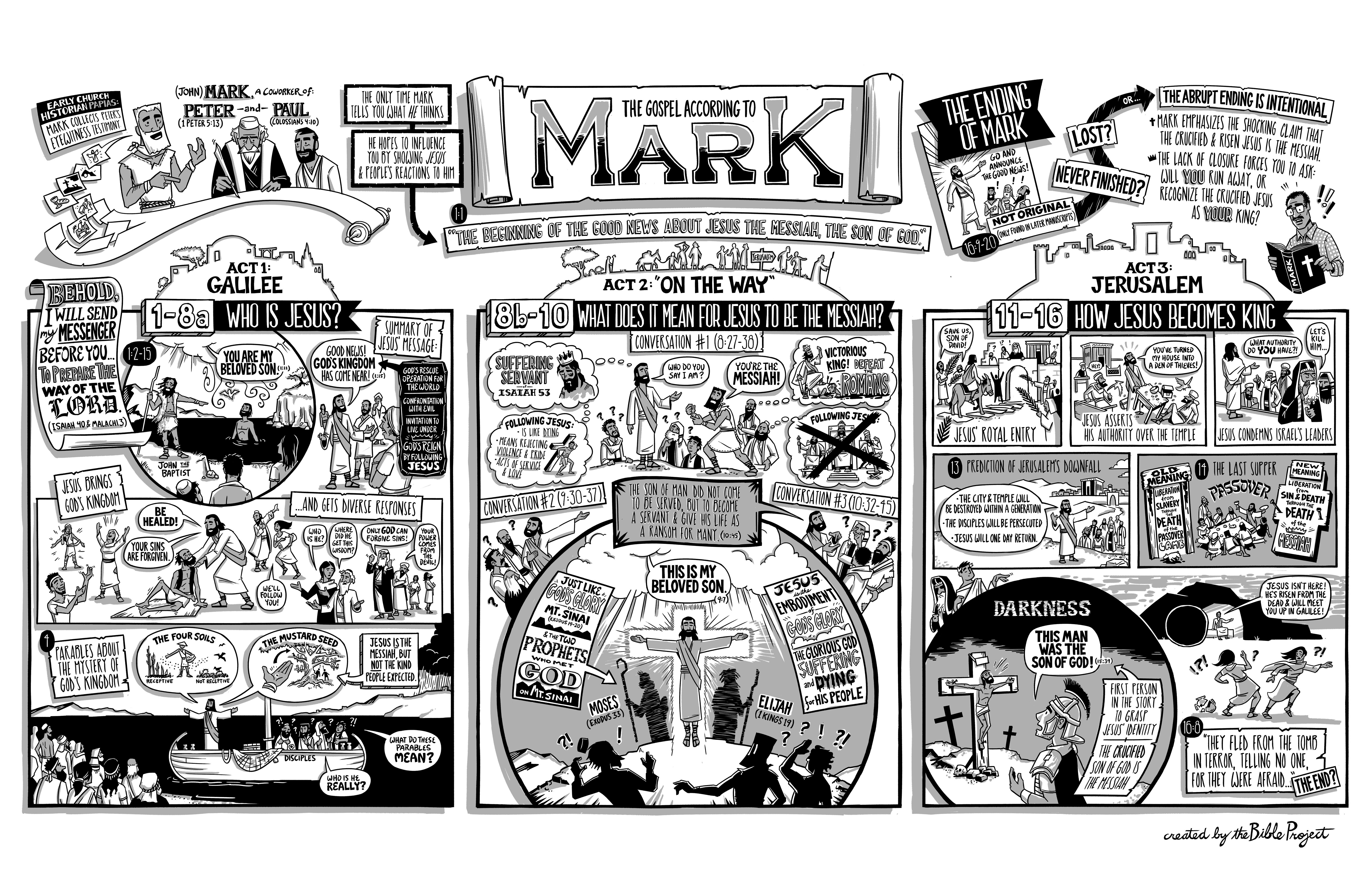
Use this visual map as your high-level orientation: Act 1 in Galilee asks who Jesus is, Act 2 on the way asks what kind of Messiah he is, and Act 3 in Jerusalem shows how Jesus becomes king.
Do not read Mark as only a collection of miracle stories. Read it as a tightly arranged narrative argument. Every healing, conflict, question, prediction, and failure of understanding is helping Mark answer one major claim: the crucified Jesus is the Messiah and Son of God.
Written for People Under Pressure
The Gospel of Mark is traditionally attributed to John Mark, a coworker of both Peter and Paul, writing most likely in Rome in the late 60s CE. The probable audience was a community of Roman Christians — people facing the threat of Nero's persecution after the fire of 64 CE, in which Christians were scapegoated and executed.
This context explains why Mark's Gospel is shaped the way it is. It is not organized as a biography for the curious — it is an urgent, fast-moving narrative argument for people who needed to know whether the suffering they were experiencing was consistent with following a crucified Messiah. Every emphasis on endurance, cross-bearing, and service over status speaks directly to that situation.
Coworker of Peter (1 Pet 5:13) and Paul (Col 4:10); likely drew on Peter's eyewitness preaching
Likely Gentile believers under persecution; Mark explains Jewish customs (7:3–4) that a Jewish audience would not need explained
The emphasis on cross-bearing, servant leadership, and a Messiah who wins through death is pastorally calibrated for people who might die for their faith
Each tab in this guide corresponds to a phase of the Project Context observational reading method. Work through the tabs roughly in order — deep literary analysis only lands once the big picture and structure are clear.
Historical and cultural context matters — but it comes after literary observation, not before. The goal of the first several passes is to hear what Mark is actually doing in the text. The Resources tab and secondary literature exist to deepen understanding, not replace reading.
The Three-Act Flow of Mark
A simple and useful way to read Mark is through its three major movements. This keeps the Gospel from feeling like a blur and helps you notice how each section develops a different part of Mark's argument.
Conflict Escalation Pattern
Even as Jesus displays authority, opposition builds in a clear four-step arc across the five conflict stories. By chapter 3 the cross is already in view — Mark plants the ending at the beginning.
| Movement | Main Question | Key Turn | What to Notice |
|---|---|---|---|
| 1:1–8:26 | Who is Jesus? | Miracles, conflict, growing amazement | Authority, secrecy, parables, partial sight, mixed responses |
| 8:27–10:52 | What does it mean that Jesus is the Messiah? | Peter's confession and first passion prediction | Three passion predictions, disciple failure, service, suffering, true greatness |
| 11:1–16:8 | How does Jesus become king? | Jerusalem entry and temple confrontation | Royal irony, judgment, Passover, cross, centurion confession, empty tomb |
Power
Jesus acts with divine authority over sickness, sin, nature, demons, and human institutions.
Misunderstanding
The disciples confess correctly but imagine the wrong kind of Messiah. Jesus must retrain their imagination.
Reversal
The Messiah is enthroned through humiliation. The cross becomes the place where his identity is finally recognized.
The Three Passion Prediction Cycles
Act 2 is organized around a repeating three-part cycle: Jesus predicts his suffering, the disciples reveal a misunderstanding, and Jesus corrects them with a teaching on cross-shaped discipleship. The pattern escalates each time — the disciples' responses grow more ambitious, the predictions more specific, and the corrections more foundational. This is Mark's way of showing that the disciples' problem is not ignorance but imagination.
Each cycle intensifies. A personal rebuke → a group argument about rank → a bold request for thrones. As the predictions grow more specific about suffering, the disciples' responses grow more ambitious about glory. The gap between what Jesus announces and what the disciples want closes only at the cross. Mark uses this three-part repetition to make one thing unmistakable: the Messiah's path is the servant's path, and there is no alternative route.
Chapter-by-Chapter Guide
Mark 1–2 · Arrival, Authority, and Immediate Conflict+
- John prepares the way; Jesus is baptized and declared God's beloved Son.
- Jesus proclaims the kingdom, calls disciples, teaches with authority, and casts out demons.
- He heals, cleanses a leper, forgives sins, calls Levi, and redefines sabbath assumptions.
Read for: authority, amazement, and the fact that conflict starts almost immediately.
The heavens are "torn open" (σχίζω — the same word used when the temple curtain tears at 15:38) — an irreversible act of God. The Spirit descends. A voice declares: "You are my beloved Son, with you I am well pleased" — weaving together Psalm 2:7 (royal sonship), Isaiah 42:1 (the suffering servant commissioned), and Genesis 22:2 (the beloved son offered). This is the first confession in the confessional arc (1:11 → 9:7 → 15:39), heard only by Jesus. The reader knows from line one what no character fully understands until the cross. The royal-priestly ordination that the Themes tab develops at length begins here, in two verses, before any miracle has been performed.
Where Matthew and Luke give forty verses of dialogue and three specific temptations, Mark gives two sentences: "He was in the wilderness forty days, tested by Satan. He was with the wild animals, and the angels were ministering to him." The compression is intentional. Mark is not summarizing Matthew — he presents the temptation as brute cosmic fact rather than a teaching scene. Satan, wild animals, and angels: the whole created order is implicated. Jesus passes through, and εὐθύς the proclamation begins.
Within the first two chapters, every major controversy trigger is established: sin forgiveness (2:1–12), table fellowship with outcasts (2:13–17), sabbath grain (2:23–28), and sabbath healing (3:1–6). The five conflict stories that follow form Chiasm 1 in the Chiasms tab — and they end with a death plot in 3:6. The cross is not an ending Mark arrives at; it is a destination he signals from the start.
Mark 3–4 · Dividing Lines and the Mystery of the Kingdom+
- Religious leaders harden against Jesus.
- Jesus appoints the Twelve and speaks about divided houses and true family.
- The parables explain why the kingdom is both present and hidden.
Read for: the growing split between openness and resistance.
When the disciples ask Jesus why he speaks in parables, his answer is one of the most theologically demanding passages in Mark: "To you the mystery of the kingdom of God has been given. But to those outside, everything comes in parables — so that they may indeed see but not perceive, and may indeed hear but not understand, lest they should turn and be forgiven." (4:11–12, drawing on Isa 6:9–10.)
Jesus is not saying he teaches obscurely to be cruel. He is saying that parables function as a kind of sifting mechanism — they hide the kingdom from those who are not positioned to receive it, and reveal it to those who have ears to hear. This connects directly to the Messianic Secret: Jesus does not simply withhold information; he filters it through a medium that responds to the posture of the hearer. The Sower parable immediately precedes this exchange and is treated as the master key: "Do you not understand this parable? How then will you understand all the parables?" (4:13) — meaning the parable of the Sower is the hermeneutical lens for every other parable Jesus tells.
Mark 5–6 · Authority Over Evil, Death, and Rejection+
- Jesus delivers the Gerasene demoniac, heals the woman, raises Jairus' daughter.
- He is rejected in Nazareth, sends the Twelve, and feeds the five thousand.
- John the Baptist's death casts a shadow over the mission.
Read for: power joined with vulnerability and rejection.
The execution of John the Baptist is the only extended flashback in Mark, and it functions as a theological shadow cast over the whole Gospel. John is an innocent man killed by political power for speaking truth. He is buried by his disciples. The very next scene has Jesus feeding a crowd in a desolate place — the juxtaposition of death and provision is deliberate. Mark is telling the reader: this is the pattern. The one who prepares the way is killed; the one he prepared for will be killed the same way. Herod's banquet (excess, vanity, lethal indulgence) contrasts with Jesus' feasts (abundance from scarcity, freely given). The mission the disciples have just returned from (6:7–13) now has a shadow over it.
Jesus crosses to the other side of the lake — Gentile territory — and encounters Legion. The healing is the most dramatic exorcism in Mark: a man living among tombs, beyond human restraint, possessed by "many" spirits. After the healing, the man wants to follow Jesus. Jesus refuses — and instead gives him a commission: "Go home to your people and tell them how much the Lord has done for you." This is the first explicit commission to proclaim in Mark, given to a Gentile, in Gentile territory, before Jesus has commissioned his own disciples to do the same. The man obeys and proclaims in the Decapolis — the ten Gentile cities. The first feeding (5000, Jewish territory) and later the second feeding (4000, Gentile territory in 8:1–10) bracket this expanding mission. Mark is planting Gentile inclusion long before the centurion's confession at the cross.
Mark 7–8 · Purity, Bread, Blindness, and Confession+
- Jesus relocates purity from external ritual to the human heart.
- He heals Gentiles, feeds another crowd, and warns about the yeast of the Pharisees.
- The blind man at Bethsaida is healed in stages, preparing for the disciples' partial sight.
- Peter confesses Jesus as Messiah.
Read for: partial understanding and the hinge into the middle act.
Jesus calls the crowd together and delivers what may be the most structurally significant teaching in Mark outside of Act 2: "There is nothing outside a person that by going into him can defile him, but the things that come out of a person are what defile him" (7:15). Mark adds a parenthetical editorial note — rare in this Gospel — "Thus he declared all foods clean" (7:19). This is not a minor point. Jesus is relocating the entire purity system from external ritual to the human heart, effectively dismantling the food laws as a boundary marker and opening the door for Gentile inclusion without Torah observance. The Syrophoenician woman (7:24–30) who follows immediately — a Gentile who receives the bread meant for Israel's children — is the first demonstration of what that looks like in practice.
The bread discourse (8:14–21) brings the ἄρτος accumulation pattern (developed fully in the Wordplay tab) to its crisis point. After two miraculous feedings the disciples are worried about having forgotten to bring bread. Jesus' response is withering: "Do you not yet perceive? Do you not yet understand? Are your hearts hardened? Having eyes do you not see?" (8:17–18). He cites both feedings and their basket counts — not to prove arithmetic, but to demand recognition: who do you think is in the boat with you? The answer should be obvious. It is not yet. Immediately after, Jesus heals the blind man of Bethsaida in two stages — the man first sees people "like trees walking," then sees clearly. This is the only healing in Mark that Jesus performs in stages, and its placement is deliberate: it is a physical map of the disciples' spiritual condition going into Act 2. They see something, but not clearly. Peter's confession follows.
Mark 8:27–10 · The Way of the Cross+
- Three times Jesus predicts his suffering, death, and resurrection.
- Three times the disciples misunderstand greatness.
- The transfiguration confirms Jesus' identity, but the path still leads downward toward Jerusalem.
- Jesus teaches about receiving children, cutting off causes of stumbling, service, marriage, wealth, and true greatness.
Read for: the difference between admiration and actual discipleship.
The transfiguration is not interrupting the suffering predictions — it is placed between them by design. Jesus predicts the cross (8:31), is transfigured in glory (9:2–8), then predicts the cross again (9:31). The sequence insists that glory and suffering are not opposites in Mark; they are the same reality approached from two directions. Moses and Elijah — the Law and the Prophets — appear and are surpassed. The voice from the cloud repeats the baptism declaration with one addition: "Listen to him" — an echo of Deuteronomy 18:15, where Moses promises a prophet like himself whom Israel must obey. Jesus is identified as that prophet. The disciples are terrified and see "no one but Jesus." Peter's impulse to build booths — to freeze the moment, to stay in glory without the cross — is the same impulse the disciples show throughout Act 2.
Act 2 closes with a blind man who sees more clearly than everyone who can. Bartimaeus calls out "Son of David" — the only time this messianic title appears in Mark, and it comes from a roadside beggar the crowd tries to silence. Jesus stops, calls him, and heals him immediately. Bartimaeus' response: "He followed him on the way" (ἐν τῇ ὁδῷ, 10:52) — the exact phrase that has defined the entire journey section. He does what the disciples have not done. He has no prior education, no place in the Twelve, no track record of following — and he follows. The Chiasms tab develops this as the closing bracket of the blind-man arch (8:22–10:52), but its narrative function here is equally important: Mark ends Act 2 with a model disciple who was blind a moment ago.
Mark 11–13 · Jerusalem and Temple Crisis+
- Jesus enters Jerusalem as king.
- He enacts judgment on the temple and confronts the leaders.
- He predicts the destruction of the temple and speaks about watchfulness under pressure.
Read for: prophetic judgment, royal authority, and the collision between Jesus and Jerusalem's leadership.
Chapters 11–12 are the most sustained debate sequence in Mark, structured as a series of six escalating authority challenges from every major leadership faction — each of which Jesus defeats, until no one dares to ask him anything further (12:34). The sequence is architecturally ordered:
When a disciple marvels at the temple stones ("What wonderful stones!"), Jesus answers flatly: "There will not be left here one stone upon another that will not be thrown down" (13:2). The rest of chapter 13 is Jesus' most sustained eschatological speech in Mark — often called the "Little Apocalypse" — structured around two concentric questions: the destruction of the temple (near-term, 70 CE) and the coming of the Son of Man (final horizon). Mark 13 requires careful reading to distinguish which references belong to which event, since Jesus deliberately holds them together.
Wars, earthquakes, false messiahs, persecution, the "desolating sacrilege" (Dan 9:27), and the flight from Judea. These events have a "you" address — the disciples' generation will see them.
Cosmic signs and the Son of Man "coming on the clouds" (Dan 7:13–14). The elect gathered from the ends of the earth. The timing is unknown — not even the Son, only the Father.
The chapter closes with a parable of a man leaving servants in charge: "Watch — you do not know when the master will return." The watchfulness Mark 13 demands is the same posture the disciples fail to maintain in Gethsemane (14:34–38) just two chapters later.
Mark 14–16 · Passover, Cross, Burial, and Empty Tomb+
- The anointing at Bethany interprets Jesus' death before it happens.
- The last supper reframes Passover around Jesus' body and blood.
- Jesus is betrayed, denied, tried, crucified, and buried.
- The centurion's confession and the women at the tomb bring the Gospel to its provocative close.
Read for: irony, fulfillment, abandonment, and the open-ended summons to witness.
Jesus goes to pray three times; returns three times to find the inner three disciples sleeping. The tripling is deliberate — it mirrors the three passion predictions in Acts 2 and structurally rhymes with Peter's three-fold denial in 14:66–72. Jesus stays awake; the disciples cannot. The cup he prays about is the one he will drink alone.
Mark 14:32–42 is the most concentrated echo of the Lord's Prayer in the Gospels — not because Jesus quotes it, but because he lives it under maximum pressure. Three specific petitions from Matthew 6:9–13 reappear as actions, not words:
"Not what I will, but what you will" (14:36) — Jesus' prayer is the Sermon on the Mount's third petition lived from the inside out.
"Watch and pray that you may not enter into peirasmon" (14:38) — Jesus uses the exact vocabulary of the Lord's Prayer to warn disciples who cannot stay awake long enough to pray it.
The cup Jesus asks to be spared is the very trial he prays his followers will be delivered from. He drinks it alone so that they will not have to drink it the same way.
The disciples' failure to stay awake is not merely a physical failure — it is a failure to pray as Jesus taught them. They cannot embody the Lord's Prayer when it costs something. Jesus can. See also: Lord's Prayer Thematic Study → Gethsemane section.
Mark timestamps the crucifixion in three-hour intervals: third hour (9 am — Jesus is crucified), sixth hour (noon — darkness falls over the land), ninth hour (3 pm — Jesus cries out and dies). This is not incidental precision; it is a liturgically shaped sequence that early Christians would have recognized as the Jewish hours of prayer. The death of Jesus is framed as a cosmic act measured by sacred time.
The earliest and most reliable Greek manuscripts — including Codex Sinaiticus and Codex Vaticanus — end at 16:8, with the women fleeing the tomb in fear and saying nothing to anyone. The longer ending (16:9–20), which includes post-resurrection appearances, the commission to handle serpents, and the promise of speaking in tongues, is absent from the major early manuscripts and reflects vocabulary and style unlike the rest of Mark. Most modern critical editions and evangelical scholars (France, Cranfield, Marcus) treat 16:9–20 as a scribal addition, likely composed to smooth Mark's deliberately abrupt close. The original ending at 16:8 is almost certainly intentional: it is a literary summons, not an incomplete manuscript. Mark leaves the reader holding the silence — the same silence the women held — and waiting to see whether they will speak.
Key Themes to Track in Mark
Identity
Mark keeps pressing the question of Jesus' identity. Demons know him, crowds wonder, disciples hesitate, and the cross reveals what power alone did not.
Kingdom
Jesus announces that God's reign has come near — but it does not arrive the way anyone expected. Mark's parables trace a four-stage arc that runs against every instinct about power:
Discipleship
Following Jesus means more than admiring his power. It means receiving his way of self-giving service, humility, and cross-bearing.
Secrecy
Jesus often silences demons or crowds because people are ready for the wrong kind of Messiah.
Conflict
Religious leaders increasingly oppose Jesus because his authority threatens their structures and assumptions.
Failure
The disciples are not flattering portraits. Their failure is part of Mark's realism and part of his invitation to readers.
Reversal
The one who serves is greatest, the last becomes first, and the king reigns from a cross before an empty tomb.
The Irony Pattern: Insiders Blind, Outsiders See
One of Mark's most consistent and striking patterns is that the people who should recognize Jesus consistently fail to, while the people no one would expect are the ones who get it right. This is not accidental — it is Mark's theological argument that seeing Jesus correctly requires a different kind of vision than religious insider status provides.
- Religious leaders — see the miracles, explain them as demon power (3:22)
- The Twelve — confess correctly, then argue about status and flee at the cross
- Jesus' hometown — knows him too well to believe him (6:1–6)
- The Syrophoenician woman — Gentile, receives faith's reward from a reluctant Jesus (7:24–30)
- Blind Bartimaeus — physically blind, calls out "Son of David" and follows on the way (10:46–52)
- The Roman centurion — at the cross, where the disciples aren't: "Truly this man was the Son of God" (15:39)
The implication: Religious knowledge and proximity to power do not guarantee spiritual sight. In Mark, seeing Jesus correctly seems to require need, honesty, and willingness to be an outsider to the world's definitions of greatness — qualities the disciples keep failing to embody.
"For even the Son of Man came not to be served but to serve, and to give his life as a ransom for many."
| Theme | Where it shows up | What it does in Mark |
|---|---|---|
| Son of God | 1:1, 1:11, 9:7, 15:39 | Frames the whole Gospel from divine declaration to human confession at the cross. |
| Kingdom of God | 1:14–15; parables in ch. 4 | Shows that Jesus is bringing God's reign, but in a form many do not expect. |
| Messianic misunderstanding | 8:27–10:52 | Exposes false expectations about triumph, greatness, and power. |
| Temple and authority | 11–13 | Shows Jesus acting with royal and priestly authority over Israel's center. |
| Fear and amazement | 4:41; 5:15; 16:8 | Keeps the reader from domesticating Jesus. He overwhelms categories. |
Jesus as the Ultimate Royal Priest
Mark is especially powerful when read with priestly and royal categories in mind. At his baptism, heaven opens and God declares Jesus his beloved Son — words blending Psalm 2, Genesis 22, and Isaiah 42 that function as a royal-priestly ordination. From there, Jesus acts like a priest operating outside the temple system: forgiving sins, restoring the impure, confronting the temple order, and quoting Psalm 110 to claim the role of the ruling priest at God's right hand. He wins the throne not through domination but through sacrificial offering — and when he dies, the temple curtain tears, releasing Eden's blessing into all creation.
Jesus as Philosopher, Prophet, and New Moses
Mark's Jesus is not only a healer or exorcist — he is a teacher of the first order, and Mark's opening summary (1:14–15) functions as the thesis statement of his entire mission: "The time is fulfilled, and the kingdom of God has come near; repent and believe the good news." This announcement draws directly from Daniel 7:22 (LXX: the time came and the holy ones possessed the kingdom) and Isaiah's herald announcing the return of Yahweh as King (Isa 40:9; 52:7).
Tim Mackie's classroom framework for Matthew applies with full force in Mark. Jesus inhabits three overlapping roles simultaneously:
New Moses
Jesus teaches God's covenant will with the authority of the One who gave the original Torah — not citing precedent but speaking in his own name ("I say to you"). His discipleship demands in Mark 8–10 are Deuteronomy-shaped: the call to follow him on the way parallels Moses' call to "choose life" at the Jordan.
Kingdom Herald
Mark's εὐαγγέλιον ("good news") in 1:1 and 1:15 is Isaiah's vocabulary (Isa 40:9; 52:7; 61:1). Jesus' healings, exorcisms, and forgiveness are not random demonstrations of power — they are kingdom-arrival events, signs that God's reign is breaking into creation and confronting everything that corrupts it.
True Philosopher
Like Israel's wisdom tradition and the ancient philosophical schools, Jesus forms a community of disciples around his person and teaching. The goal is not information transfer but character formation — producing people who embody the values of the kingdom and can distinguish between the way that leads to life and the way that leads to ruin.
Mark's compressed summary of Jesus' message ("The kingdom of God has come near") is the same announcement that saturates Matthew's Sermon on the Mount. For Mark, this is not an abstract theological claim — it is a declaration that the cosmic sovereignty promised in Daniel 7:13–14 to the "one like a Son of Man" is now arriving in Jesus' person and actions. Every miracle, exorcism, and act of forgiveness in chapters 1–8 is a demonstration of this arrival, not merely a display of power.
The Confessional Arc
Mark does not explain who Jesus is at the beginning and let the story prove it. He structures the entire Gospel around the question of identity — and the answer arrives in three carefully placed divine and human confessions, moving from heaven to earth, from private to public, from first to last.
"You are my beloved Son, with you I am well pleased." Heaven speaks at the baptism. The audience is Jesus alone. The ordination is royal-priestly (Ps 2 + Isa 42). No human hears it.
"This is my beloved Son, listen to him." Heaven speaks again at the Transfiguration. Three disciples hear it — but are commanded to silence. The midpoint of the Gospel, just after the cross is announced.
"Truly this man was the Son of God." A Roman centurion — the last person expected, watching from the foot of a cross — gets the answer right. The only human in Mark to confess correctly without being silenced.
The progression: Private → semi-private → public. Divine voice → divine voice → human voice. Jewish setting → Jewish mountaintop → Roman execution. And the only person who confesses openly in the public square is a Gentile soldier standing at the cross. That is Mark's Christology in three sentences.
The Shema Exchange
The closest thing to a mutual creedal dialogue in Mark. A scribe asks about the greatest commandment. Jesus answers with Deuteronomy 6:4–5 (the Shema) joined to Leviticus 19:18. The scribe then recites the answer back — paraphrasing, affirming, and adding: "more than all burnt offerings and sacrifices" (v. 33).
That addition is striking: the scribe embeds a critique of the temple cult inside his agreement with Jesus. Jesus responds: "You are not far from the kingdom of God." This is the only exchange in Mark where Jesus and a Jewish teacher reach agreement — and it happens in the temple courts, days before the crucifixion.
Chiastic Structures in Mark
Mark is not just a rapid-fire story collection. He is a careful literary architect who layers chiastic patterns at multiple scales simultaneously — three major arches spanning large sections of the gospel, six nested and micro chiasms operating inside them, and six intercalation sandwiches woven throughout. Seeing them all at once reveals a compositional intelligence rarely appreciated at the popular level.
Three large-scale structures carry the weight of the entire Gospel. Each spans multiple chapters and places a theologically decisive center at its pivot. These are the load-bearing arches of Mark's composition.
The Five Conflict Stories
Mark opens Jesus' public ministry with five controversy stories arranged in a careful arch. The center — the question about fasting and new wine — is the theological hinge: Jesus is not patching an old system but bringing something entirely new. The outer pairs mirror each other around that claim.
The Way of the Cross — Blind Man Bookends
The entire middle section of Mark is framed by two healings of blind men (Bethsaida, 8:22–26; Bartimaeus, 10:46–52). Between them, the disciples progressively fail to "see" Jesus for who he is. Three passion predictions anchor three symmetrical cycles of misunderstanding and correction. Note: Chiasms 5 and 6 are nested within this structure's C′ arm.
The Passion Trial Chiasm
The trial and crucifixion sequence forms a precise chiastic arch where Jewish and Roman settings mirror each other, with the Roman judgment at the center. Each panel ironically crowns and mocks Jesus even as it reveals his true identity. Chiasm 9 (Crucifixion Climax) follows immediately after this structure at 15:33.
These structures operate inside the macro chiasms — the arms of the larger arches are themselves architecturally organized. Each card shows the parent structure in grey; lit arms indicate where the nested chiasm lives.
The Covenant Community — Greatness, the Little Ones, and Peace
This unit forms the theological heart of the C′ arm. It opens with disciples competing for status and closes with a command to be at peace — the same community, reordered by Jesus' definition of greatness. The pivot at v. 42 applies maximum rhetorical force to everything before it. Note that the chiasm straddles two arms of Chiasm 2: it begins inside the D center (9:33–37) and extends into C′ (9:38–50).
Discipleship Teaching — Covenant, Children, and Wealth
The second half of Chiasm 2's C′ arm (following Chiasm 5) is itself chiactically organized around a central encounter. Three domains of discipleship — marriage, children, wealth — converge on the rich man's question, which is answered symmetrically on both sides: who receives the kingdom (b/b′) and what covenant commitment costs (a/a′).
Gethsemane — Prayer, Sleep, and the Hour
The garden scene forms a tight concentric structure around one center: the disciples' inability to watch and pray. Jesus' prayer brackets their failure on both sides, making the contrast impossible to miss. This unit immediately precedes Chiasm 3 (14:53) — the will of the Father settled in the garden before the trial begins.
The Crucifixion Climax — Darkness, Cry, and Confession
The seven verses immediately following Chiasm 3 form a precise five-beat arch that is the theological apex of the entire Gospel. Cosmic darkness brackets human misunderstanding at the center, and the passage moves from dereliction cry to death cry to public confession — with the temple veil as the final act of God.
These self-contained structures do not nest inside the macro chiasms — they operate independently within a single discourse or narrative unit. Both are in structural dialogue with the macro chiasms that surround them.
The Parable Discourse — Hearing and the Secret of the Kingdom
The only extended teaching discourse in Mark's Act 1 is itself chiactically organized. The center is not a new parable — it is the interpretation of the first one, signaling that the ability to hear and understand is itself the point. The outer pairs are parables about growth; the inner pairs are about the conditions for receiving the word.
The Jerusalem Controversy Chiasm — And the Scribe Who Almost Saw It
Mark deliberately mirrors Chiasm 1 (the five Galilee conflicts) with five Jerusalem controversy stories arranged in the same arch pattern. The Galilee center declared new wine; the Jerusalem center produces a scribe who is "not far from the kingdom" — almost, but not quite, seeing what Jesus is. The two chiasms frame the entire gospel ministry.
Mark's most distinctive compositional tool is the intercalation — often called a "Markan sandwich." He interrupts Story A with Story B, then completes Story A. The interrupting story interprets the outer story, and vice versa. Mark uses this at least six times.
When you see Mark interrupt a story with another story, pause and ask: How does the inserted story interpret the outer story? How does the outer story reframe the inserted one? The meaning lives in the gap between the two. Mark never uses the sandwich accidentally. Note: the sixth and final sandwich (14:53–72, Jesus' trial / Peter's denial / trial) is treated above as Chiasm 3, where its mirror structure carries the fullest theological weight.
Structured Patterns in the Crucifixion Narrative
Mark's passion account (chapters 14–16) is not raw reportage — it is architecturally shaped. Two triadic patterns frame the cross from opposite directions: one from mockery, one from witness.
Three Mockers at the Cross (15:29–32)
Ordinary people walking past. They wag their heads and mock the temple claim. The crowd — anonymous Israel.
Religious leadership. "He saved others; he cannot save himself." The irony is sharpest here — they are accidentally correct in the deepest theological sense.
Those crucified alongside him join the mockery. Even the condemned revile their fellow condemned. Every social layer has rejected him.
Three Women Witnesses — Inclusio (15:40 / 15:47 / 16:1)
Mary Magdalene, Mary mother of James and Joses, and Salome. Named, watching from a distance while the Twelve are absent.
Mary Magdalene and Mary mother of Joses. They observe where the body is laid — establishing continuity between the death and the empty tomb.
The same three women return at dawn. They are the only continuous witnesses across the passion — cross, burial, resurrection. The disciples who ran are not here. The women are.
Every identified chiastic and mirror-pattern structure in Mark, mapped against the chapter timeline and rated by confidence. The arc map shows all nine at once — the density of Mark's architectural intelligence made visible.
| # | Name | Reference | Type | Confidence | Nested In |
|---|---|---|---|---|---|
| 1 | Five Conflict Stories | 2:1–3:6 | Macro | Definite | — |
| 2 | Way of the Cross | 8:22–10:52 | Macro | Definite | — |
| 3 | Passion Trial | 14:53–15:32 | Macro | Definite | — |
| 4 | Parable Discourse | 4:1–34 | Standalone Micro | Definite | — |
| 5 | Covenant Community | 9:33–50 | Nested | Definite | Chiasm 2 · D/C′ |
| 6 | Discipleship Teaching | 10:1–31 | Nested | Strong | Chiasm 2 · C′ |
| 7 | Jerusalem Controversies | 12:13–40 | Standalone Micro | Definite | — |
| 8 | Gethsemane Prayer | 14:32–42 | Nested | Strong | Passion Narrative · pre-Chiasm 3 |
| 9 | Crucifixion Climax | 15:33–39 | Nested | Strong | Passion Narrative · post-Chiasm 3 |
| — | Prologue ↔ Empty Tomb | 1:1–13 / 16:1–8 | Macro | Proposed | — |
Wordplay & Verbal Patterns in Mark
Mark writes in relatively simple Koine Greek, but his simplicity is strategic. He returns to key words repeatedly, positions them at structural turning points, and sometimes uses the same word across wildly different scenes to create irony or depth. These patterns are lost in translation unless you know to look for them.
Mark's signature word. He uses it more than any other NT writer — nearly once per paragraph in chapters 1–6. It creates a breathless, urgent, forward-hurtling narrative momentum. Jesus does not reflect; he acts. The kingdom does not wait; it arrives. Scholars sometimes call this Mark's "parataxis" style: rapid short sentences linked by καί ("and") and εὐθύς.
The urgency is not accidental. Mark presents a world in the grip of evil that needs decisive rescue — and a king who moves without delay. When εὐθύς clusters slow in the passion narrative (chapters 14–16), the contrast is striking: here the pace changes to deliberate suffering.
One of Mark's most theologically loaded words. It operates on three levels simultaneously: (1) the literal road from Galilee to Jerusalem; (2) the messianic way prophesied in Isaiah 40:3 ("Prepare the way of the Lord") — which Mark quotes in 1:2–3; and (3) the way of discipleship that Jesus himself defines.
The climax of Act 2 is perfectly positioned: Bartimaeus is healed and immediately "followed him on the way" (10:52 — ἐν τῇ ὁδῷ). He models what the disciples throughout chapters 8–10 refused to do. The whole journey section is framed as a question: will you follow Jesus on his way?
Mark uses this violent, irreversible word exactly twice — and the two uses form the Gospel's deepest structural bracket. At the baptism, the heavens are "torn open" (σχιζομένους) and God declares Jesus his Son (1:10). At the death, the temple curtain is "torn in two" (ἐσχίσθη) from top to bottom (15:38). Both are unambiguously acts of God. Both are followed by a declaration of Jesus' identity.
Heavens tear → Spirit descends → "You are my Son" (divine voice, private)
Curtain tears → Darkness ends → "This man was the Son of God" (human voice, public)
The word does not mean "open gently." It means rip. Mark is saying that Jesus' arrival and death are world-rupturing events. The barrier between heaven and earth — represented first by the sky at the Jordan, then by the veil before the Holy of Holies — does not open; it is destroyed.
τοῦ ἀνθρώπου
Jesus' self-designation appears in three distinct clusters that trace the arc of the whole Gospel: authority → suffering → glory. Mark never explains the title; the reader is expected to trace its trajectory and feel its weight building.
2:10 forgives sins · 2:28 Lord of Sabbath
8:38 returns in glory · 13:26 on the clouds · 14:62 at God's right hand
The middle cluster (suffering) is the largest: 8:31, 9:9, 9:12, 9:31, 10:33, 10:45, 14:21 (×2), 14:41. Mark uses the title most densely in Act 2 — the same section structured by the blind-man chiasm — to insist that the route from authority to glory runs through the cross. The Daniel 7 figure who receives the kingdom comes to earth not to be served, but to give his life as a ransom (10:45).
Mark's "rebuke" word carries exorcism-level authority. It is the word Jesus uses to silence unclean spirits (1:25), to rebuke a fever (in parallel accounts), to silence the crowd's messianic acclaim (3:12), and — most shockingly — to rebuke Peter (8:33) with the words "Get behind me, Satan."
The irony is structured: in 8:32, Peter "rebukes" (ἐπιτιμᾶν) Jesus for predicting the cross. In 8:33, Jesus rebukes (ἐπετίμησεν) Peter right back using the same word he uses against demons. The verbal echo is intentional. Mark is saying Peter's resistance to the cross is not merely misguided — it belongs to the same category as demonic opposition.
In the central section of Act 1, the word "bread" (ἄρτος) accumulates with deliberate intensity: the feeding of the 5,000 (6:30–44), Jesus walking on water while the disciples "did not understand about the loaves" (6:52), the controversy about bread and tradition (7:1–23), the Syrophoenician woman's reply about "children's bread" (7:27–28), the feeding of the 4,000 (8:1–10), and the disciples arguing about having no bread in the boat (8:14–21).
Jesus ends the sequence with a frustrated double question: "Do you not yet understand? Do you not yet perceive?" (8:17–18). He lists both feedings and asks: "How many baskets?" The point is not mathematics. The point is that the disciples should have understood who he is from the bread. Mark is weaving eucharistic and identity themes together — the one who multiplies bread is the one who will give his body (14:22).
In 8:34, Jesus calls the crowd and his disciples and says: "If anyone would come after me, let him deny himself" (ἀπαρνησάσθω ἑαυτόν). The same verb appears nowhere else in Mark until the passion — when Peter denies (ἀπαρνήσομαι) Jesus three times (14:30–31, 72).
The irony is devastating. Jesus calls disciples to self-denial; Peter practices a different kind of denial entirely — he denies his Lord rather than himself. Mark has pre-loaded the word in chapter 8 so that the reader feels its full weight when it reappears in chapter 14. Peter did not deny himself to follow Jesus on the way. Instead, he denied Jesus to save himself.
This intensified compound verb — "looked around on all sides" — is virtually unique to Mark among the Gospels. It always describes Jesus' gaze, never anyone else's in this form. It appears at moments of confrontation, challenge, or intimate recognition. The word creates a characteristic Markan scene: Jesus stops, slowly scans the room or crowd, and acts with deliberate divine authority.
This is one of Mark's most vivid portrait touches. Matthew and Luke tend to smooth it over, but Mark keeps it because it communicates something about Jesus' searching, knowing, authoritative gaze.
One of Mark's most distinctive literary features is its willingness to show Jesus' emotional interior in ways that Matthew and Luke frequently edit out or soften. This is not incidental — it is Mark's Christology in action: the Son of God has a fully human inner life, and Mark wants you to feel it.
Gut-level compassion — the visceral, physical word for mercy. Used of Jesus moved by a leper, by a crowd without a shepherd, and by the hungry crowd. Mark and Luke use it of Jesus; Matthew also uses it in parables. It is never flatly translated by "felt sorry."
Stern intensity — a snorting, forceful word usually translated "sternly charged" or "sternly warned." After healing the leper (1:43) and rebuking the waste of nard (14:5). It conveys something closer to righteous intensity than gentleness.
Deep sighing — used uniquely by Mark. At 7:34, Jesus looks up to heaven and "sighs" before healing the deaf man. At 8:12, he "sighs deeply in his spirit" when the Pharisees demand a sign. The sigh is not frustration alone — it is the sound of someone who carries the weight of what he sees.
Anger and grief together — at 3:5, Jesus looks around the synagogue "with anger, grieved at their hardness of heart." Two emotions held simultaneously. Matthew and Luke omit the anger. Mark keeps it because it shows Jesus' response to willful blindness is not detached — it costs him something.
Amazement — Jesus is amazed at the unbelief in Nazareth (6:6). This is the only place in the Synoptics where Jesus is the subject of the amazement verb rather than the cause of it. Mark presents a Jesus for whom the failure of faith is genuinely surprising — not omnisciently bypassed.
Distress and anguish in Gethsemane — "greatly distressed and troubled." The first word means something closer to alarmed or overwhelmed; the second means a restless, unsettled anguish. Again, Matthew softens this; Mark does not. This is not performance — it is the full weight of the cup landing on a fully human person.
What makes this pattern significant is what it says about Mark's Christology. He is not afraid to show a Jesus who sighs, grieves, is startled, and is moved in his gut — because this is precisely what the incarnation requires. The portrait is not weakened by these emotions; it is deepened. The Son of God fully enters human experience, and Mark wants every reader to feel that.
"Do you not yet understand? Do you not yet perceive? Are your hearts hardened? Having eyes do you not see, and having ears do you not hear?"
Mark's "blindness" vocabulary (βλέπω, ὁράω, ὀφθαλμός, τυφλός) runs through the whole Gospel as a spiritual diagnostic. The two blind men who are healed (8:22–26, 10:46–52) bracket the section where the disciples are most spiritually blind. Meanwhile, the demons always "see" Jesus clearly, the woman with the hemorrhage "sees" her healing, and finally a Gentile centurion "sees" and confesses at the cross (15:39). Mark asks the reader: which kind of seeing do you have?
Suggested Reading Plan
This plan lets you read Mark in manageable units while keeping the flow intact. Each day includes a core focus so you know what to watch for on that pass through the text.
Best Practice for a Second Pass
- Read the whole Gospel in one sitting if possible.
- Then read again with a pencil and mark every question people ask about Jesus.
- On a third pass, mark every place the disciples fail to understand.
- On a fourth pass, track what Jesus says about the cross, service, and following him.
Study Questions for Mark
Questions organized by type and depth. Work through the first two sets on your own before reading secondary material. The later sets are designed for group discussion or extended study. Each question maps back to a specific section of this guide — use the tab references to go deeper.
Observation — First-Pass Questions · Use while reading the text
- Count the word "immediately" (εὐθύς) in chapter 1. How many times does it appear? How does this change the feel of the narrative compared to the passion narrative in chapters 14–16, where it slows sharply? [→ Wordplay tab · εὐθύς]
- List every scene where someone asks a question about Jesus' identity — "Who is this?" or equivalent. Who asks it, when, and does Jesus answer? What pattern emerges? [→ Themes tab · Identity]
- Track the word "way" (ὁδός) through chapters 8–10. Mark every occurrence. What are the characters doing on the way, and who is walking with Jesus when the journey ends at 10:52? [→ Wordplay tab · ὁδός]
- After each of the three passion predictions (8:31, 9:31, 10:33–34), what do the disciples do or say? Write down each response side by side. Does anything escalate? [→ Structure tab · Three Prediction Cycles]
- Mark every command to silence in the Gospel: who is silenced, by whom, and in what circumstances? Are there any exceptions where Jesus does not silence? [→ Themes tab · Secrecy]
- Where do fear (φόβος) and amazement appear together in the same scene? What triggers both at once? What does this suggest about what Mark wants the reader to feel in those moments?
Structure & Literary Design · For second and third passes
- The five conflict stories (2:1–3:6) end with a death plot in 3:6 — only chapter 3. How does knowing the cross is already planned by chapter 3 change how you read the miracles and authority displays of Act 1? [→ Structure tab · Conflict Escalation; Chiasms tab · Chiasm 1]
- Pick one Markan sandwich (intercalation) — either 3:20–35, 5:21–43, 6:7–30, 11:12–25, or 14:1–11 — and explain specifically how the inserted story reframes the outer story. What would be lost if Mark had told the two stories in sequence rather than weaving them? [→ Chiasms tab · Markan Sandwiches]
- The transfiguration (9:2–8) is placed between Passion Prediction 1 and Passion Prediction 2. Why does Mark put the glory scene there rather than at the end? What does the placement argue about the relationship between glory and suffering? [→ Chapter Guide · Mark 8:27–10]
- Act 2 (8:22–10:52) opens and closes with the healing of a blind man. Bartimaeus (10:46–52) responds by following Jesus "on the way." Compare his response to the disciples' behavior throughout the entire section. What contrast is Mark constructing? [→ Chiasms tab · Chiasm 2]
- Mark 16:8 ends with the women fleeing in fear, "and they said nothing to anyone, for they were afraid." This is almost certainly the original ending. What does the abruptness demand of the reader that a tidy resurrection appearance would not? [→ Chapter Guide · Mark 14–16 · Textual Note]
- In chapters 11–12, Jesus faces six consecutive challenges from every major religious faction. Map each challenger and each response. What does the sequence as a whole demonstrate about Jesus' authority, and why does it end with Jesus asking his own question about Psalm 110? [→ Chapter Guide · Mark 11–13 · Six Challenges]
Wordplay & Language · Greek verbal patterns
- The verb σχίζω ("to tear/rip") appears exactly twice in Mark: 1:10 (heavens torn at baptism) and 15:38 (curtain torn at death). What happens immediately after each tearing? Why does Mark use such a violent, irreversible word rather than "opened" or "parted"? [→ Wordplay tab · σχίζω]
- In 8:32–33, Peter uses the verb ἐπιτιμάω to rebuke Jesus, and Jesus uses the same verb right back. Where else does this word appear in Mark — and to what or whom is it directed? What does using exorcism language in both directions suggest? [→ Wordplay tab · ἐπιτιμάω]
- Jesus commands "deny himself" (ἀπαρνησάσθω ἑαυτόν) at 8:34. The same root verb reappears when Peter denies Jesus at 14:30–31 and 14:72. What irony has Mark constructed across these six chapters? What did Peter deny, and what should he have denied? [→ Wordplay tab · ἀπαρνέομαι]
- Mark shows Jesus angry (3:5), sighing deeply (7:34, 8:12), gut-level moved (1:41, 6:34), and overwhelmed with anguish (14:33–34) — emotions Matthew and Luke frequently soften or remove. Why might the other Evangelists edit these out? What is at stake Christologically in keeping them or removing them? [→ Wordplay tab · Emotional Portrait]
- Jesus asks "Do you not yet perceive? Do you not yet understand? Are your hearts hardened?" (8:17–18), echoing Isaiah 6:9–10 and Jeremiah 5:21. Who originally received that "hardening" oracle in Isaiah's context? Why would Mark want readers to recognize that echo in a boat full of disciples? [→ Wordplay tab · ἄρτος]
- The "bread" cluster (ἄρτος) saturates chapters 6–8: two feedings, a controversy over tradition, the Syrophoenician woman's crumbs, a boat conversation, and finally the Last Supper. Trace the thread. What question is Jesus asking in 8:17–21, and how does 14:22 answer it? [→ Wordplay tab · ἄρτος]
Intertextual & Theological · OT echoes and canonical connections
- Mark 1:2–3 quotes Isaiah 40:3 to introduce John — the voice crying in the wilderness, "prepare the way of the Lord." How does knowing this background change the meaning of ὁδός every time it appears in chapters 8–10? What is Jesus doing when he walks the "way" to Jerusalem? [→ Wordplay tab · ὁδός]
- When Jesus says "where their worm does not die and the fire is not quenched" (9:48), he is quoting Isaiah 66:24 — the final verse of the entire book. What is the broader context of Isaiah 65–66 (new creation, the vision of renewed worship)? What does Gehenna mark the boundary of? Why does Jesus cite the whole book's closing image to address the disciples' power struggle? [→ Chapter Guide · Mark 8:27–10; Gehenna Thematic Study →]
- The parable of the Sower (4:3–20) is followed immediately by Jesus explaining that parables both reveal and conceal (4:10–12). He calls the Sower "the parable" — the master key for all the rest. How does the Sower itself enact the principle it describes? What do the different soils represent about the posture of hearers? [→ Chapter Guide · Mark 3–4 · Why Parables?]
- Mark 13 draws on Daniel 7:13–14 ("Son of Man coming on the clouds") and Daniel 9:27 ("desolating sacrilege"). Jesus has used "Son of Man" fourteen times across the Gospel tracing authority → suffering → glory. How does the Olivet Discourse bring those three threads together? [→ Wordplay tab · Son of Man; Chapter Guide · Mark 11–13]
- In Gethsemane, Jesus prays "Not what I will but what you will" (14:36), warns the disciples to watch and pray "that you may not enter into testing" (14:38, using πειρασμόν — the same word as the Lord's Prayer), and drinks a cup he asked to be spared. How does this sequence function as a lived-out version of three Lord's Prayer petitions? What does the disciples' inability to stay awake suggest about their prayer life? [→ Chapter Guide · Mark 14–16 · Lord's Prayer in the Garden; Lord's Prayer Thematic Study →]
- The baptism (1:9–11) blends Psalm 2:7 (royal coronation), Isaiah 42:1 (servant commissioning), and Genesis 22:2 (beloved son sent). How does each of these OT texts shape what happens next in Mark — the temptation, the ministry, and ultimately the cross? [→ Themes tab · Royal Priest Lens; Chapter Guide · Mark 1–2]
Identity, Messiahship & Royal Priest · Who is Jesus in Mark?
- The three divine/human confessions in Mark move from private to public, divine voice to human voice, Jewish setting to Roman execution: 1:11 → 9:7 → 15:39. What changes with each step? Why is the only openly correct human confession made by a Gentile soldier at a moment of maximum defeat? [→ Themes tab · Confessional Arc]
- Where in Mark does Jesus exercise authority that belongs exclusively to the temple priesthood — forgiving sins, declaring someone clean, acting with authority in the temple courts? Build a list. What accumulates when you see these scenes together? [→ Themes tab · Royal Priest Lens]
- Mark 4:10–12 presents Jesus explaining that parables conceal the kingdom from "those outside." The silence commands after healings work similarly. Both patterns delay full disclosure. What does it mean for a Messiah to be simultaneously available and hidden? Why must the cross come before the identity can be fully public? [→ Themes tab · Secrecy; Chapter Guide · Mark 3–4]
- Jesus quotes Psalm 110 at 12:35–37 ("The Lord said to my Lord, 'Sit at my right hand'") to argue the Messiah is greater than David. The crowd listens "with delight." What is the claim Jesus is making about himself, and why does the response differ from every other debate in chapters 11–12? [→ Themes tab · Royal Priest Lens]
- When the temple curtain tears at 15:38, Mark immediately follows with the centurion's confession at 15:39. The same σχίζω tear that opened heaven at the baptism now removes the barrier before the Holy of Holies. What does this sequence claim about what Jesus' death accomplishes for access to God? [→ Wordplay tab · σχίζω; Themes tab · Royal Priest Lens]
Irony & Narrative Reversals · Mark's most consistent technique
- The irony pattern runs throughout Mark: insiders (scribes, Pharisees, disciples, Jesus' family) are blind to who he is; outsiders (the Syrophoenician woman, Bartimaeus, the centurion, the unnamed woman at Bethany) see clearly. Build the full list of outsiders who get it right. What do they have in common? What do the insiders have in common that prevents them from seeing? [→ Themes tab · Irony Pattern]
- At the crucifixion, the chief priests mock: "He saved others; he cannot save himself" (15:31). Mark intends this as an unintentional theological truth. What does the mockery accidentally confess? How does it fit Mark's larger claim that the Messiah wins by losing? [→ Chiasms tab · Passion Trial Chiasm]
- The unnamed woman at Bethany anoints Jesus' head — a royal act — before his death (14:3–9). Jesus says "wherever the gospel is proclaimed, what she has done will be told." She is sandwiched between the plot to kill Jesus (14:1–2) and Judas' agreement to betray him (14:10–11). What is the structural and theological point of her placement? [→ Chiasms tab · Sandwich 5]
- Mark 13 ends with the parable of the absent master whose servants must watch: "you do not know when the master will return." Two chapters later, in Gethsemane (14:32–42), Jesus returns three times to find the disciples asleep. They failed to watch. Is this intentional? What does it say about the gap between hearing Jesus' teaching and actually living it? [→ Chapter Guide · Mark 11–13 · Olivet Discourse]
Personal & Group Reflection · For small groups and individual formation
- Mark's irony pattern places religious insiders on the blind side and outsiders on the seeing side. Without pretending you know which you are, where in your life do you most closely resemble the disciples — people who confess the right title but imagine the wrong kind of Messiah?
- The three passion predictions and their corrections address three different failure modes: Peter's avoidance of suffering (8:32), the disciples' argument about status (9:33–34), and James and John's ambition for position (10:35–37). Which of these three failure modes is most alive in you right now?
- Jesus responds to the greatness argument by placing a child in the center of the circle (9:33–37). The child represents those with no status to trade on. Who in your community has no status currency to offer — and is their presence welcome, or merely tolerated?
- Gethsemane shows Jesus praying three petitions of the Lord's Prayer under maximum pressure. Which of these — "your will be done," "do not lead us into testing," or "deliver us from the evil one" — is hardest for you to mean honestly when you pray it?
- Mark's ending leaves the women fleeing in silence. The Gospel does not resolve for you — it presses you. The question Mark closes with is not "what did they do?" but "what will you do?" What would it mean for you personally to break the silence?
- Which version of Jesus in Mark is hardest to receive: the one who acts with gut-level compassion (σπλαγχνίζομαι), the one who sighs deeply at unbelief, the one who is genuinely anguished in Gethsemane, or the one who is abandoned by everyone at the cross? What does your answer reveal about your actual Christology?
Several passages in Mark connect to dedicated thematic and book studies on Project Context. These are the most directly relevant for extended research beyond this overview guide.
Gehenna, Isaiah 66, Daniel 12, and the New Creation. Full five-movement seminary-level treatment of Mark 9:42–50 in its biblical frame.
Structure, theology, OT intertext, and Gethsemane as embodiment. Directly relevant to Mark 14:32–42 and the three petition echoes in the garden.
All Mark pages on Project Context — book study pages, thematic studies, and character profiles connected to the Gospel.
Practical Reading Tools
- Questions people ask about Jesus.
- Commands to silence or secrecy.
- Moments where fear and amazement appear together.
- Every passion prediction.
- Every place the disciples misunderstand greatness.
- Royal and priestly language in chapters 11–15.
- Q = key question about Jesus
- M = misunderstanding
- K = kingdom statement or action
- X = conflict with leaders
- C = cross-shaped discipleship
- R = royal or priestly signal
| Text to Anchor | Why It Matters |
|---|---|
| Mark 1:15 | Summarizes Jesus' kingdom announcement. |
| Mark 1:11 | Royal-priestly ordination at baptism (Ps 2 + Gen 22 + Isa 42). First confession in the confessional arc. |
| Mark 8:29 | Peter's confession marks the hinge of the Gospel. |
| Mark 8:34 | Discipleship triad: "deny himself / take up his cross / follow me" — three imperatives, likely an early catechetical formula preserved verbatim. |
| Mark 9:7 | Second divine confession: "This is my beloved Son, listen to him." Midpoint of the confessional arc. |
| Mark 9:35 | Redefines greatness. |
| Mark 10:45 | "The Son of Man came not to be served but to serve, and to give his life as a ransom for many." Widely recognized as a pre-Markan creedal formula (France, Marcus) — the theological resolution to the entire discipleship section. |
| Mark 12:32–33 | The Shema creedal exchange: scribe recites Deut 6:4–5 + Lev 19:18 back to Jesus, adding "more than all burnt offerings." Temple critique embedded inside a creed. Only mutual agreement between Jesus and a teacher in Mark. |
| Mark 12:35–37 | Psalm 110 citation — Jesus claims the royal-priestly role. |
| Mark 15:38–39 | Curtain torn + centurion confession: "Truly this man was the Son of God." Third and climactic confession in the confessional arc (1:11 → 9:7 → 15:39) — the only public human confession, from a Gentile. |
Mark is meant to move you, not merely inform you. It is a Gospel of pressure, urgency, fear, failure, revelation, and decision. Read it with your eyes open for the cross at the center and for the way Jesus keeps redefining what power, kingship, priesthood, and discipleship really mean.
This is the systematic reading method behind the whole guide. Work through these phases over multiple sittings — each one builds on the one before it. The guardrail: observe what the text does before consulting any tools.
Resources for Reading Mark
Sources organized by category using the Project Context 5.8.1 bibliography format. BibleProject video and classroom resources are listed first as they provide the primary framing methodology. Academic commentaries and specialized studies follow. All sources are cited in Chicago Manual of Style, 17th edition.

BibleProject Video & Classroom Resources
Primary framing resources — the interpretive methodology behind this guide
BibleProject Video & Classroom Resources
Primary framing resources — the interpretive methodology behind this guide
Gospel of Mark
Royal Priest Theme
Mark Overview Poster (printable): Download 44-Mark-FNL.jpg
Gehenna Word Study
Classroom — Messianic Torah & Rise of the Messiah
Thematic Studies Referenced in This Guide
On BibleProject sources: Video transcripts and classroom notes are used as primary framing resources reflecting Tim Mackie's methodology of literary design, canonical reading, Hebrew wordplay, and intertextual connections — the interpretive approach that shapes Project Context studies.
Mark Commentaries
Primary exegetical sources for the Gospel of Mark
Mark Commentaries
Primary exegetical sources for the Gospel of Mark
Major Academic Commentaries
Son of Man & Christology
Isaiah, Intertextual Connections & Gospel Methodology
The OT narrative background and approach to reading the Gospels as literature
Isaiah, Intertextual Connections & Gospel Methodology
The OT narrative background and approach to reading the Gospels as literature
Isaiah & New Exodus
Kingdom & Gospel Reading
Kingdom Background & Jesus' Teaching Method
Primary & Reference Sources
Greek and Hebrew critical texts, lexicons, and Second Temple literature
Primary & Reference Sources
Greek and Hebrew critical texts, lexicons, and Second Temple literature
Critical Texts
Lexicons & Reference Works
Second Temple & Jewish Sources
Citation Format: Chicago Manual of Style, 17th edition.
On usage tags: Tags reference the tab in this study guide where each source most directly informs the content. Sources may inform multiple tabs.